
This guide covers the Bang Pa-In Royal Palace, the summer retreat of Thai kings, located south of Ayutthaya. For the full context of the main historical park ruins, read the Ayutthaya Historical Park guide.
- 1Key Takeaways
- 2Quick Facts
- 3What is Bang Pa-In Royal Palace? A Clear Definition
- 4What This Guide Is NOT
- 5The Main Buildings
- 6The History (The Short Version)
- 7How to Get to Bang Pa-In Royal Palace
- 8Costs and Budget
- 9Best Time to Visit
- 10Essential Tips and Etiquette
- 11Where to Go Next
- 12The Contrarian Truth About Bang Pa-In Royal Palace
- 13Summary
Key Takeaways
- This is not a ruin. It is a fully restored, active royal palace. The Thai royal family still uses it for ceremonies.
- The architecture is a deliberate mishmash of Thai, Chinese, and European styles. King Rama V loved European palaces and built accordingly.
- The dress code is strictly enforced. This is a royal palace, not a temple ruin. No shorts, no sleeveless shirts, no ripped jeans. You will be turned away.
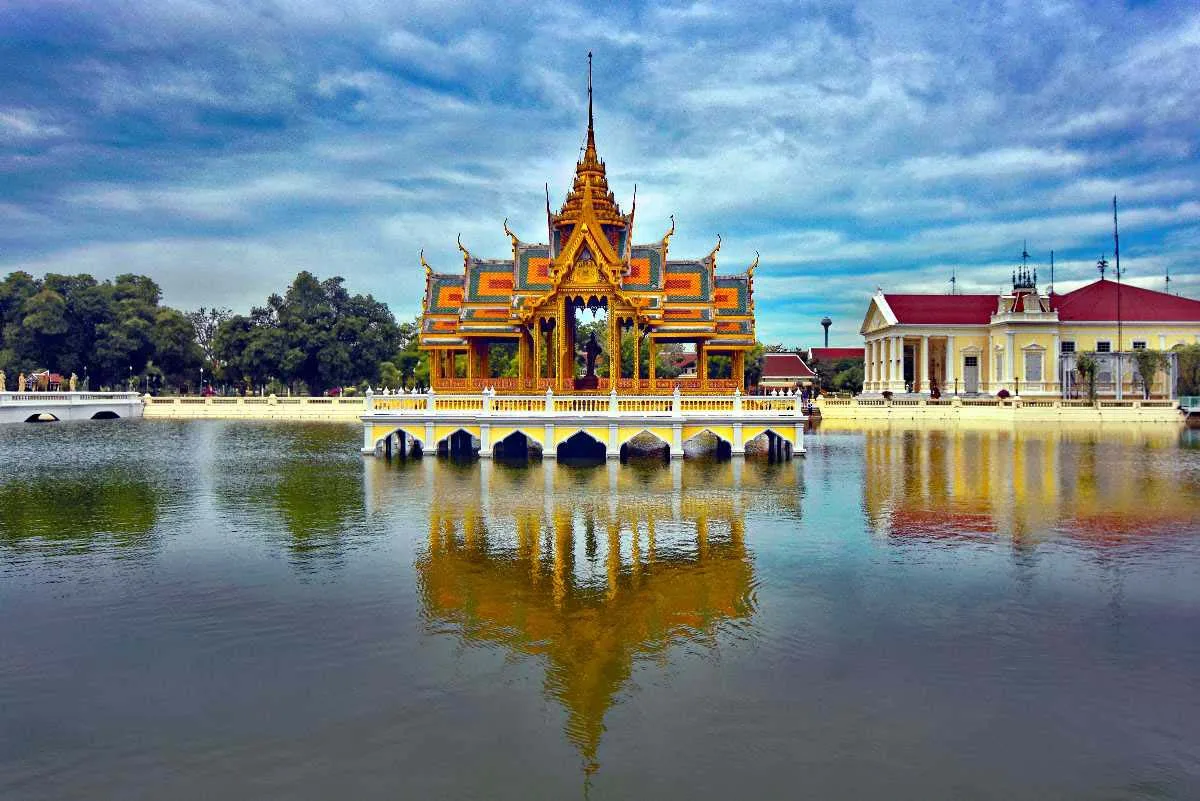
- The floating Thai pavilion (Aisawan Thiphya-Art) is the iconic photo. Do not leave without seeing it.
- Combine this with your Ayutthaya trip. It is 20 kilometers south, on the way back to Bangkok.
Quick Facts
| Category | Detail |
|---|---|
| Location | Bang Pa-In District, Ayutthaya Province, 20 km south of Ayutthaya city |
| Built | Originally 17th century (King Prasat Thong). Most current buildings from 19th century (King Rama V). |
| Original Purpose | Summer retreat for Thai kings |
| Current Status | Active royal palace (ceremonial use) |
| Architectural Styles | Thai, Chinese, European (eclectic) |
| Entry Fee | 100 THB |
| Dress Code | Very strict. Shoulders and knees covered. No ripped jeans. No see-through clothing. |
| Best Time to Visit | November to February (cool, dry). 8:00 AM or 3:00 PM for best light. |
| Time Needed | 2-3 hours |
What is Bang Pa-In Royal Palace? A Clear Definition
Bang Pa-In Royal Palace (พระราชวังบางปะอิน) is a royal palace complex used by Thai kings as a summer retreat. It was originally built in the 17th century by King Prasat Thong (the same king who built Wat Chaiwatthanaram). After falling into ruin, it was restored and expanded by King Rama IV and King Rama V in the 19th century.
King Rama V (King Chulalongkorn) is responsible for most of the buildings you see today. He traveled extensively in Europe and brought back architectural ideas. The result is a unique, eclectic mix of Thai, Chinese, and European styles.
Unlike the ruins of Ayutthaya, this is a living palace. The grounds are meticulously maintained. Several buildings are still used for royal ceremonies.
For the context of the main historical park, read the Ayutthaya Historical Park guide.
What This Guide Is NOT
This is not a guide to ancient ruins. It is not a budget backpacker spot (the entry fee is higher). It is also not a place to wear your temple-visiting flip-flops and shorts. Dress properly or you will not be let in.
The Main Buildings
| Building | Style | Notes |
|---|---|---|
| Aisawan Thiphya-Art Pavilion | Traditional Thai | The floating pavilion in the middle of a pond. The most famous structure. Built as a memorial. |
| Wehart Chamrun Palace | Chinese | A two-story mansion built by Chinese merchants in 1889. Intricate wood carvings. A throne room inside. |
| Ho Withun Thasana (Royal Observatory Tower) | European (stripped) | A striking red and yellow tower. Climb to the top for a panoramic view of the entire palace grounds. |
| Phra Thinang Uthayan Phumisathian | European (Italian Renaissance) | A grand mansion. It was originally built as a residence. It was rebuilt after a fire. Now used for royal ceremonies. |
| Warophat Phiman Hall | Neoclassical | The main reception hall. Used by King Rama V to welcome foreign dignitaries. |
Do not just take a photo of the floating pavilion. Walk to the back. See the Chinese mansion. Climb the tower. The grounds are larger than they appear from the entrance.
The History (The Short Version)
| Period | Event |
|---|---|
| 1632 CE | King Prasat Thong builds a simple palace on the site. |
| Late 18th century | The palace falls into ruin after the fall of Ayutthaya. |
| 19th century | King Rama IV (Mongkut) begins restoration. |
| Late 19th century | King Rama V (Chulalongkorn) expands the palace extensively. He builds most of the current structures. |
| 1938 | A fire destroys the original Phra Thinang Uthayan Phumisathian. It is later rebuilt. |
| Present | The palace is used for occasional royal ceremonies and is open to the public. |
The palace as you see it today is largely a 19th-century creation. It is not “ancient” in the way that Wat Mahathat is ancient. That does not make it less interesting.
How to Get to Bang Pa-In Royal Palace
| Method | From | Cost (Approx) | Time | Notes |
|---|---|---|---|---|
| Private car/taxi | Ayutthaya city | 400-600 THB (round trip) | 30 minutes | The most convenient. Ask your driver to wait. |
| Tuk-tuk | Ayutthaya city | 500-800 THB (round trip) | 30-40 minutes | Negotiate a round-trip price including waiting time. |
| Train | Ayutthaya train station | 15-50 THB | 20 minutes | Take a southbound train to the Bang Pa-In station. From there, it is a 20-minute walk or a short motorbike taxi. |
| Bicycle | Ayutthaya city | 40-60 THB/day | 1.5-2 hours | Only for experienced cyclists. The roads are busy. Not recommended for most tourists. |
From Bangkok, you can also take a train directly to Bang Pa-In station. It is a common day trip from Bangkok as well as from Ayutthaya.
Costs and Budget
| Item | Approx Cost (THB) |
|---|---|
| Palace entry fee | 100 |
| Boat ride (optional, in the palace canals) | 20-30 |
| Water and snacks | 20-50 |
| Total for this site | 100-200 THB (excluding transport) |
Best Time to Visit
| Season | Weather | Crowds | Verdict |
|---|---|---|---|
| Nov-Feb | Cool, dry, pleasant | High | Best time. Go early (8:00 AM) to beat the tour groups. |
| Mar-May | Very hot (35-40°C) | Low | Not recommended. There is limited shade on the open lawns. |
| Jun-Oct | Afternoon showers, humid | Low | The gardens are green and lush. Bring a raincoat. |
The single most important tip: Go at 8:00 AM when it opens. The light is good for photos of the floating pavilion. The heat is bearable. The tour groups from Bangkok arrive between 10:00 AM and 11:00 AM.
Essential Tips and Etiquette
- Dress code is strictly enforced. This is a royal palace. No shorts. No sleeveless shirts. No ripped jeans. No see-through clothing. You will be denied entry.
- Remove your shoes before entering any building. There will be shoe racks outside.
- Do not climb on the structures. The floating pavilion is a memorial. The Chinese mansion has roped-off areas.
- Do not touch the thrones or any royal artifacts.
- Bring water and sunscreen. There is a lot of walking outside on open lawns.
- Rent an umbrella at the entrance if it is raining. They are available for a small deposit.
Where to Go Next
Bang Pa-In is on the main road between Bangkok and Ayutthaya. It is best combined with a trip to the historical park.
- Visit in the morning (8:00-11:00 AM).
- Then continue north to Ayutthaya city.
- Spend the afternoon at the Ayutthaya Historical Park.
- See Wat Mahathat and Wat Chaiwatthanaram in the late afternoon.
The Contrarian Truth About Bang Pa-In Royal Palace
This is not an “authentic” 17th-century palace. Most of what you see was built or rebuilt in the 19th century. King Rama V was heavily influenced by European architecture. The result is a royal Disneyland of styles, not a pure historical artifact.
That does not make it bad. It makes it a fascinating document of 19th-century Thai modernization. Come for the architecture. Come for the gardens. Do not come expecting a pristine ancient ruin.
Summary
Bang Pa-In Royal Palace is a royal palace complex in Ayutthaya Province, Thailand. It was originally built in the 17th century and extensively rebuilt in the 19th century by King Rama V. The palace is known for its eclectic mix of Thai, Chinese, and European architecture. The floating Thai pavilion (Aisawan Thiphya-Art) is the most famous structure. The palace is still used for royal ceremonies. The entry fee is 100 THB. The dress code is strictly enforced (covered shoulders and knees). It is located 20 kilometers south of Ayutthaya city.
Bang Pa-In Royal Palace is the perfect morning stop on your way to the Ayutthaya ruins.
- Start here at 8:00 AM.
- Continue to the Ayutthaya Historical Park by late morning.
- See the famous Wat Mahathat and the sunset at Wat Chaiwatthanaram.
Plan your whole day with the Ayutthaya Historical Park guide.
This article is part of Ayutthaya cluster. Be sure to also read about: Ayutthaya Floating Market, Royal Elephant Kraal, Ultimate Fun Guide to Ayutthaya, Ayutthaya vs Sukhothai, Guide to Exploring the Ayutthaya Kingdom, Wat Ratchaburana, Wat Tha Ka Rong, Wat Yai Chai Mongkhon, Bang Pa-In Royal Palace, Wat Phra Si Sanphet, Wat Chaiwatthanaram, Wat Mahathat, Ayutthaya Historical Park
You Might Also Like
Wat Tha Ka Rong: The “Carnival Temple” of Ayutthaya
This guide covers Wat Tha Ka Rong, the quirky “Carnival Temple” of Ayutthaya. For the full context of…
Wat Phra Si Sanphet: Ayutthaya’s Golden Crown
This guide covers the royal temple of Wat Phra Si Sanphet in Ayutthaya. For the full context of…
Ultimate Fun Guide to Ayutthaya: Beyond the Ruin Fatigue
This guide covers the fun, non-temple side of Ayutthaya. For the main historical park and temple ruins, read…